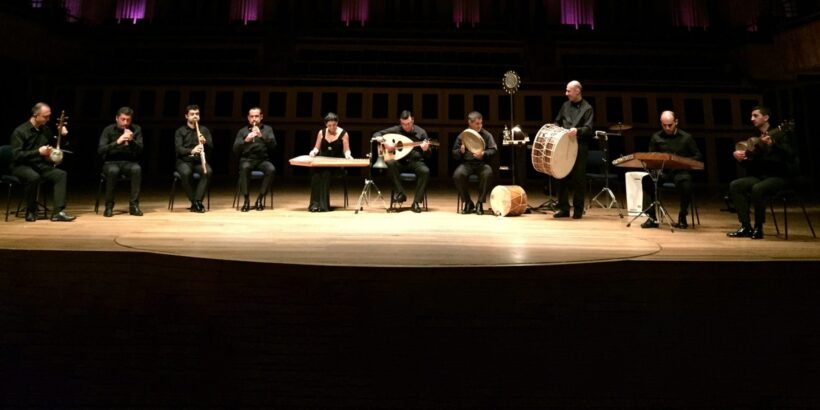
On 20 September 2025, I had the great fortune to be present at a concert by the Gurdjieff Ensemble (formerly the Gurdjieff Folk Instruments Ensemble) in the historic Black Fortress, Armenia. It was the concluding event, and – I would say – the climax of a three and a half day conference organised by Prof. Peter Cowe of UCLA, and Anahita, his wife, together with a team from Yerevan State University and sundry other people. I am grateful to them for making it possible.
This was the most powerful concert I have ever attended because it enlightened me a little further as to what music can be, or perhaps more precisely, what it is. It opened my mind to new realities and possibilities. Namely, in the finale of the concert, the Great Prayer, I experienced music as coming from another world. It is impossible to quite put it into words, but I had the distinct impression that a very fine force was emanating from a higher world than this one, and was being manifested through the players, and through them to us. There was no fantasy in this unexpected impression: it was as concrete as the sensation of my body on the chair I was sitting on.
It was brought home to me (rather than being my conclusion), that the inner states of the members of the ensemble were, collectively, one of the critical elements, and that the Gurdjieff/de Hartmann music was another, and the folk instruments were a third. We the audience were an element, too; and so too was the Black Fortress, the good acoustics of which facilitated it. But my sense was that the music was the chief factor, followed by the inner work of the players, and the instruments.
I cannot really explain it, but this, at least, seems true to me: there were special vibrations. These vibrations exist in a higher world. They correspond to something in the music, at least to some of the pieces, most especially the Great Prayer, and the Chant from a Holy Book – but not only those. The vibration of the folk instruments and the being-state of the players, was in harmony with the music, and with and through the music to that higher vibration. It must also be that something in us and the venue also corresponded. But in the end, all I can say is that the sound which we were receiving in our bodies (organic and psychic) was the resonance of a vivifying vibration from a higher world.
Background
I have previously reviewed an album by the Ensemble: https://www.josephazize.com/2017/01/26/music-of-georges-i-gurdjieff-a-review/ The line-up, according to their web-site (https://gurdjieffensemble.com/) is Levon Eskenian – (founder), arranger, artistic director/ Emmanuel Hovhannisyan – duduk, zourna, pku/ Avag Margaryan – blul, zourna/ Armen Ayvazyan – kamancha/ Aram Nikoghosyan – oud/ Meri Vardanyan – kanon/ Vladimir Papikyan – santur, voice/ Davit Avagyan – tar, saz/ Mesrop Khalatyan – dap, dhol/ Norayr Gapoyan – duduk/ Eduard Harutyunyan – tmbouk, cymbals, bell. The Gyumri State Music Academy Choir directed by Arpine Manukyan sang in the Great Prayer.
On a purely artistic level, they were excellent. The sound was very well balanced, something I doubt could be easy when such a diverse range of ancient instruments is employed. This has to be related to the arranging, I would think, as the arranger has to minimise the chance that an instrument will be drowned out, or another one dominate all the others. They have to blend like colours in a carpet. Sometimes a critical work is performed by an instrument you barely notice at first hearing. Arranging is a real art: which instrument at this point to carry that line, and which one to follow? How to bring diversity without losing continuity? The piano simply cannot match an ensemble for breathing life into such potentially rich music.
The Concert
It is no paradox to say that the being-efforts made by Eskenian and the ensemble made the performance what it was. Without that, even the wonderful music would not have had the effect it did. In fact, it is worse to play the music negligent of its spiritual dimension than not to play at all. I have not been told that they comprise an esoteric group, or use Gurdjieff’s techniques, but I suspect that Levon and at least some of them do. If I am wrong on that, and I could well be, then their effort is a testament to the quality of the music and their attitudes and commitment. They would be more than obyvatels (in Gurdjieff’s terms). For example, discussing it with friends afterwards, it was noted that the members of the ensemble had relaxed but vigilant attention all the way through. There was no fidgetting. One friend of mine, who is only on the fringes of the Work, was struck by how present they seemed to be.
I will not repeat what I wrote in my earlier review about the sonority of the folk instruments, or quote once again Thomas de Hartmann’s important reference to Gurdjieff’s approach to the miracle of music. And I use that word “miracle” quite deliberately. What he said and what I have written coincide: music can manifest the laws of a higher world in this one.
But before I do, three important points. First, as well as The Great Prayer, they performed the music for Thirty Gestures. I am not particularly fond of that music, but Mr Eskenian’s arrangement did give it a lift which I have never heard in piano renditions. I think it would be true to Gurdjieff’s hopes, as well as just a very good idea, for the Movements to be done to the accompaniment of this music – even if a smaller ensemble of instruments is used. But imagine how intense it would be to work at The Great Prayer with this music. I have a sense it would be almost too powerful to bear. So, to Levon and the ensemble, if you need someone to help you with Movements, or you would like to pursue this question further, I am at your service.
The second point is that the recorded albums can be purchased and downloaded, and donations made, from their site: https://gurdjieffensemble.com/discography/ https://gurdjieffensemble.com/support-us/
The third point is this: wonderful as music is, there is no substitute for being present at a performance and having the vibrations of the players and their instruments enter your body directly. None. As a general rule, it is like the difference between being present at a play and watching the performance from a DVD. But again, there is something in the timbre, the body of the sounds of these instruments, which does somewhat bridge the gap. Personally, I usually prefer to play only one or two tracks at a time, but to listen with full attention. However, the concentrated force of the one and a half hour concert was not just memorable – it was indelible.
Unfortunately, the Gurdjieff Ensemble website is currently out of date and doesn’t include a link to their excellent 2023 album ‘Zartir’ containing both ‘Thirty Gestures’ and ‘The Great Prayer’. It can be purchased from their label (ECM)’s website: https://ecmrecords.com/product/zartir-the-gurdjieff-ensemble-levon-eskenian/.
Thank you for a great article describing and explaining what Gurdjieff’s work is about and how the ensemble was able to genuinely connect the audience to the essence of Gurdjieff’s mysticism. I had the zoom link but was unable to watch the event. Your article gave me the satisfaction of a great experience. Thank you again!
Hripsime
Music IS, perhaps, the law of the higher dimensions. Or forms a significant part thereof. The books of the Bible refer to both the divinity and music in so many examples. Virtually all references to music in the Bible hold such meanings.
The first, in the cosmogeny of the book of Genesis, says, “And the spirit of God moved upon the face of the waters”… the Hebrew word used, ‘rachaph’ means ‘vibrated’, introducing the (musical) concept that God is reality, and reality resonates, on all levels. If the music we listen to is to truly embody such concepts, the musicians must be committed, conscious, and (perhaps?), highly moral beings.