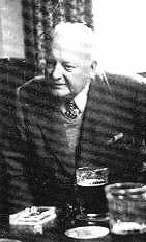
I am undertaking a study of the achievement of Maurice Nicoll (1884-1953), which, I hope, shall result in one or two books. In the course of this study, I have re-read, and made substantial notes from volume 1 of his five volume Psychological Commentaries on the Teaching of Gurdjieff and Ouspensky. These volumes are still in print: in fact, Eureka Books regularly sells out their stock, and just as regularly reprints them.
As I re-read, I was struck by how often Nicoll quotes or alludes to Gurdjieff. Some of these references are enlightening, and are worthy of some consideration. I shall number them for convenience.
1. When my wife and I were in France, G. said : “If you will not pity yourself, I will pity you.” Nicoll does not really expand on this, but he seems to be distinguishing this sort of conscious pity from the negative emotion known as “self-pity.” There is a piece of Gurdjieff-de Hartmann music named “To Pity Oneself.” Mr Adie drew my attention to it several times, referring to its powerful chordsd, and saying that it was Jeanne de Salzmann’s favourite from the musical corpus. Perhaps that music expresses something of what the conscious pity of Gurdjieff might have been like. Pitying myself. It is something to meditate on, to contemplate. (p.98, the 24th commentary, 3 January 1942)
2. He quotes the poem from The Struggle of the Magicians: “God is difficult to understand for He is first One, then Three, and then Seven.” Oddly, he does not name Gurdjieff, or the scenario, simply referring to “an ancient saying.” (p.115, the 28th commentary, 7 February 1942).
3. Nicoll wrote: “Long ago someone asked G. what Fa 96 signified: the answer was that if you had sufficient quantities of this Hydrogen “fleas would not bite you.” I think Nicoll understands this as referring as much to what we might call “internal fleas” as to the bothersome insects. (p.190, the 44th commentary, 21 November 1942)
4. “G. once said to me that opium has a higher Hydrogen in it which people can become conscious in sometimes. He said it is like becoming conscious in the plant; but you know a man must create higher Hydrogens in himself by trying to give himself first of all the First Conscious Shock, and, if he can, the Second Conscious Shock, which set going new octaves in the development of all Hydrogens in his body.Obviously, everything after the semi-colon is his expansion of G.’s comment, but it is still a gem. It seems to me to be saying that drugs which seems to offer higher consciousness in fact limit us to what is within the possibilities of the poppy plant. (p. 205, 47th commentary, 14 December 1942)
5. “‘We have’, G. once said to us, ‘to reach a point in the work when however we are turned and twisted we never lose sight of our aim.” (p.207, 47th commentary, 14 December 1942, see also 676 in volume 3). Nicoll returns to this in a subsequent commentary, from a different perspective, and not using the word “aim”: “Great knowledge is not easy to understand. But I will remind you here of what was said in the last paper—namely, that if this Work becomes real and living to a man and so well organized in him that he does act from the Work, and remembers himself in daily life, that he acts from the Work and no longer from himself, then there is something organized in him and this is Second Body. But for this to take place a man must never forget what he is doing in the Work. He must, as G. once said, reach a state such that, in whatever direction he is twisted and turned, however badly he is treated, he never forgets the Work, and never acts save through the medium of the Work.” (p.226, 51st commentary, 17 January 1943)
6. Another unattributed “saying” which I suspect is Gurdjieff, is: “A man is first one, then two, and then one.” It is necessary, and advisable to read the commentary to understand what this is referring to. (p.213, 49th commentary, 9 January 1943)
7. “When my wife and I went to the Institute in France, G. said: “Remember, Personality has scarcely any right to exist here.” Think what that means! How difficult it is to speak to people in the Work who value themselves, people who have precious ideas of themselves. They have their feelings of themselves or their particular forms of self-love. And it is the basis of self-love, self-conceit and self-admiration that has to be shifted—and how difficult it is! And you will see that a man or a woman who really thinks well of himself or herself will not be able to hear the Work-ideas. A person who has a strong sense of his or her virtue will at the same time have a strong sense of my and me.” Once more, his comments help understand Gurdjieff’s comments. (p.238, 53rd commentary, 1 February 1943). Nicoll returns several times to this saying of Gurdjieff’s.
Thus, he later wrote: “At the Institute in France we were told on entering that “personality has scarcely any right to exist in this place.” But we merely heard the phrase. We did not realise what it meant—save later.” (p.296, 67th commentary, 22 May 1943) Likewise p. 476, 116th commentary, 15 July 1944.
See also 937, 8 August 1946, 226th commentary, Nicoll refers to this saying, adding” The will of Personality had to be sacrificed …” etc.
Finally on this theme, “… Vanity is always wrong except, as it were, in very small doses. As you know, it was always said by G. that personality has scarcely any right to exist. When you ascribe some success to yourself, it goes to strengthen the false personality and so increase the Vanity in you. One is allowed to ascribe a very little to oneself, for a short time, but our trouble is that we like to talk about our successes or about what we did and what we said. And even if we are silent, we think it.” (p.359, 86th commentary, 27 November 1943) See also pp.1239 and 1260.
Nicoll also quotes extensively from the then unpublished text of In Search of the Miraculous, at pp.202, 210-213, 226-235, 239-242, 250-252, 258, 279-281, 283, 301-302, 307-308, and 350. This is about 7% of the entire book – and it is a large one!
to be continued