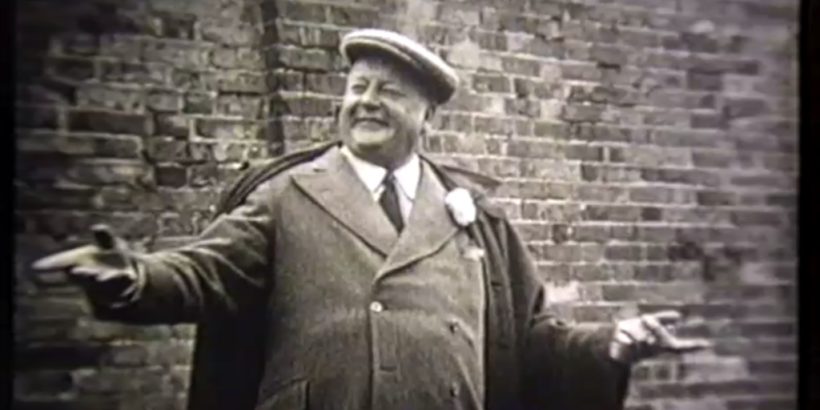
In the Maurice Nicoll Papers, Yale University Library, MS 1348, series 1, Box 3, folder 13 are 188 pages of his science study (at least several pages are missing, and a number are effectively blank). Each chapter is dated. Dates range from 17 September 1944 through to 8 November 1944. In these papers, Nicoll says, on several occasions, that Gurdjieff told him that: “… one of the objects of this Work was to unite the wisdom of the East with the science of the West, and … used to emphasise this many times, and sometimes look at me when he said it …” (1, etc.) His intention was to produce papers on chemistry, physics, biology, and – more concisely – mathematics and mathematical symbols.
From the evidence of these papers, incomplete as it is both because never finished and because pages are missing, Nicoll’s intention was to first sketch some of the findings of chemistry and other sciences, extrapolating as he went along to what we might call “Fourth Way principles;” then, at certain points, to explicitly try and relate his reading in the sciences to his understanding of the Fourth Way.
Then, just a few days ago, the University of Edinburgh Library sent me many documents from their collection of unpublished diaries and papers. I now set out – with due acknowledgement and gratitude to the UoE, a short paper of about 1,000 words dated 6 July 1937 of – to my mind – astonishing clarity and power. This surely could have, or even was intended to, serve as either the introduction or conclusion to the science papers.
6 July 1937
Science thinks that the world is logical. If we say that the world is alogical, what can it mean? Things are not necessarily explained by the same principle. Through a principle we view a thing from one standpoint. But there may be two or even three principles that are “final,” just as well as one, and by that I mean principles that cannot be resolved further or brought into a comprehensible union in terms of the kind of thinking that we possess. The world will then appear to be alogical, while in the thought of a greater mind, using another logic, it will appear logical. It is realised today that we must get beyond “visual conceptual thinking” – simply taking things as we see them. It is realised, for example, that we cannot explain light – from one point of view – and that quantum physics requires a new sort of thinking. And if the universe is more dimensional than appears to our senses and if our logic conforms to our senses, ultimate reality must be alogical to us if ultimate reality embraces all possible dimensions. But an alogical universe does not mean one toward which we can only assume an irresponsible attitude. If it is beyond our grasp it means only that all our findings concerning it are relative and we can still always interpret individually. We need not be slaves to any fixed opinion about it or feel compelled to believe that any scientific theory has permanent or absolute value.
Psychologically this means a freeing of the inner spirit of man. There will always be something left over, something not explained, not finally disposed of – so that a man can feel that he can always think {2} for himself and no his own view of the meaning of his existence.
Otherwise, science will always tend to take away the liberty of thought and people will continue stupidly to quote some scientific theory as final, about which they probably know nothing themselves and which they use merely in order to avoid the exercise of their own powers of thinking – and this ladder puts them in danger of mass-thought which leads to the degeneration of the individual, the lowering of national strength and depth of character and inner differentiation, essential to a healthy organism.
Science is everywhere plunging into deeper mysteries and is certain about nothing, and on all sides is confronted by the alogicalness of things. It is really demanding a development of the mind, a capacity for a new thinking, and a deeper insight; and this is in curious contrast to the general effect of science on the masses which has led to an extraordinary superficiality – and ignorance – as if people thought that at last the key to things had been discovered and that all problems would soon be disposed of. One human trait is the transparency of responsibility. In regard to using their own minds people have transferred responsibility to science.
It is the psychological result of this transference of responsibility that we have to consider. Psychological truth is more important than physical truth in so far as the inner well-being of man is concerned. Whatever develops a man in himself, whatever increases his inner strength and opens his understanding and gives meaning and internal balance to his life is of far more importance than machinery.
Among all the external scientific improvements {3} man is apt to lose sight of himself in the increasing complication of surrounding things. The meaning of knowledge today is not about the knowledge of meaning. Knowledge has become confined to external knowledge, do knowledge gained through the senses, to knowledge about things, to external facts. As a result man is more under the power of things than ever before. The slavery to machinery – the fact that the machines are controlling humanity as did once the Titans in legends, is increasingly evident. There is not only a disbelief but an actual hostility shown towards any other kind of knowledge. Man is expected to create a new order of existence by means of a knowledge of facts about the external world, about the body, about electricity, chemistry, technical methods etc. But everything that man has done recently, every upheaval that has taken place in the name of liberty has resulted in an apparent deprivation of liberty. And why mankind believes that liberty is only a question of an alteration of external conditions, of a killing off of one class or another, of force majeur, of a mass organisation of society or industry, or a ‘scientific’ regulation of an entire people, is one of the questions which can only be understood through a study of the general tendency of things since the scientific age began its reign. For behind it all there must be a spirit, or general attitude, that is in some way inimical to human individual freedom and well-being. If this spirit is negative, if it is nourished by hatred – as a hatred of anything not capable of proof by its method – and only a {4} supreme dramatis could shew us what is really happening everywhere today and open our eyes to the nature of this epoch.
To include science in a free spiritual interpretation of nature is the task before humanity – to free it from increasing bondage and slavery. And the reason for this can be psychologically explained. Man cannot grow in himself save through those fine sides of himself which can respond to influences beyond purely material fact. In the interpretation of nature lies the first possible step of inner development. According to how he thinks so he can be. And although the gulf between thought and being is great the starting point lies here. Man is given a world of inconceivable and marvellous complexity to begin with – and this world science studies patiently. He is “given it” because his senses open straight onto it from birth. What he makes of it, what he sees, depends on something that is internal – let us say, on his understanding. If his conclusions are negative, if he beholds nothing, or if merely adopts current opinions, words and phrases, without thinking for himself, he shuts within himself his powers of individual evolution.
Hi Joseph.
I have seen confusion on-line about the picture of Nicoll used in your post.
It is a screen shot I took from the video of Nicoll’s group at Great Amwell in 1947. I used it in my Gofundme.com fund-raising and elsewhere.
The video is available at: http://www.youtube.com/@jeffreyadams6738
Just thought you should know.
Best,
Jeffrey
Much appreciated.