The Maurice Nicoll Papers, Yale University Library, MS 1348, series 1, Box 3, folder 13. 188 pages, many pages are missing, and a number are effectively blank. Each chapter is dated. Dates range from 17 September 1944 through to 8 November 1944. I have numbered the pages from the first page to the last in one continuous sequence, allocating numbers for missing pages where I can be fairly sure how many are lacking.
In these papers, Nicoll says, on several occasions, that Gurdjieff told him that: “… one of the objects of this Work was to unite the wisdom of the East with the science of the West, and … used to emphasise this many times, and sometimes look at me when he said it …” (1, etc.) His intention was to produce papers on chemistry, physics, biology, and – more concisely – mathematics and mathematical symbols.
From the evidence of these papers, incomplete as it is both because never finished and because pages are missing, Nicoll’s intention was to first sketch some of the findings of chemistry and other sciences, extrapolating as he went along to what we might call “Fourth Way principles;” then, at certain points, to explicitly try and relate his reading in the sciences to his understanding of the Fourth Way.
On 26 September 1944, he wrote:
On one occasion I was speaking to Mr O(uspensky) on my difficulty in understanding financial and legal business, and he said it was necessary to understand something about everything even if very little. He used the expression, you must have some idea of it.” And in the same way in the Fourth Way, one of those object is to unite the wisdom of the East with the science of the West, a general aim is for everyone to know something about everything. (119)
In that same lecture, he recalled:
I once said to O. that it was an extraordinary thing that through some knowledge of this Work it became possible to read and study and think and feel in every direction, so much so that everything one read became interesting whether it was a bad or a good book. He said, “Yes, this Work makes everything fall into its place, and then you see where it comes in and what it is about; because this Work gives a whole point of view and an understanding of the whole thing.” (120)
The first set of papers is dated 17 September 1944, and is headed:
1. Chemistry
a. Quality and Quantity
b. Brain
Introduction to Scientific Paper
It opens with a section in brackets:
“(In view of the fact that I was taught that one of the objects of this Work was to unite the wisdom of the East with the science of the West, and that G. used to emphasise this many times, and sometimes look at me when he said it, it has seemed to me good to write introductions to the different sciences that exist today in the Western world.” He adds that he has long felt a dearth of any suitable introductions to the sciences and is proposing three main papers (chemistry, physic and biology) and one shorter one on mathematics and mathematic symbols.
He defines chemistry as “the supreme science of transformation of material substances.” I wonder what the non-supreme sciences might be. The changing of substances, one into the other is, he says “a series of miracles.”
One aspect of the miracles (p.2) is how from only a relatively small number of elements and “different kinds of atoms” come the great multiplicity we see around us. Another is how: “When two different elements unite they invariably produce an entirely new thing.” Thus the gases hydrogen and oxygen unite to form water, a liquid. Nicoll singles out carbon as “the most interesting element in chemistry” for its “extraordinary power of combining with other elements …”
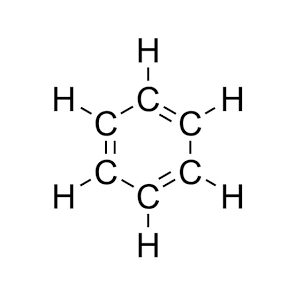
Pages 3 and 4 are missing. Page 5 deals with methane. I cannot understand it. Page 6 is missing. Pages 7 features the ring carbon which makes up benzine. It has the letters CH (Carbon, Hydrogen) in six places, joined by lines. Then, beneath, he has the same for carbolic acid or phenol: it is identical except that it has one OH (oxygen, hydrogen) link added, replacing one of the hydrogens. This will become significant at p.18 below.
Page 8 comes to inorganic chemistry, and that: “In chemistry you can practically always get back to the original elements of which the compound is composed.” Pages 10 and 11 are missing.
Page 12 opens with an enigmatic reference to argon, but without the previous pages, I cannot even guess what Nicoll’s take was. This page ends by saying that in the ancient world they had a philosophical view that “every natural thing” was composed of particles; and leaves space for quoting the Ionian philosophers.
Synthesis is the first idea on page 13: that complex substances can be manufactured in a laboratory, but whether they are exactly the same as when they occur naturally is another question:
In anything to do with this chemical analysis and synthesis of the substances produced in the body, there is always the question of the influence of other finer substances which remain undetected. The body is a chemical laboratory of enormous complexity in which every department is connected with every other department in the most bewildering way, and the problem of how this intricate chemistry was built up remains a complete …
And at this critical moment, the page ends, and we have no page 14! This seems to me to be what the previous pages have been working up to. What he seems to be leading to is: from the East, we know that the body is capable of hosting extraordinary phenomena—the basis for these miracles is the chemical make-up of the body.
On page 15, the next surviving one, he is saying that different substances are also produced by plants, e.g. opium from the poopy, and digitalis from foxglove. Significantly, it is not known why they produce those substances; a matter which cannot be brushed aside as trivial since plants make quite different compounds from the same elements (16).
However, the view that everything is simply a combination of atoms and particles “is only a partial vision which unfortunately is taken as ultimate truth.” (17). The fact that the same elements produce “such different qualities” is a mystery (17). It is beyond us to explain why the presence or absence of some atoms should make so large a difference in qualities as it does: “No one could possibly predict the qualitative difference between benzene and carbolic acid by the addition of an OH group replacing an atom of hydrogen in the benzine ring.” This is significant because “our human experience lies in qualitative differences.”
Science, he says, puts quantity prior to quality; but, he wonders, perhaps nature is experimenting with quantities to produce qualities: “The point is that if certain combinations of quantities inevitably produce certain qualities, can we be certain the qualities are secondary to quantities and not in some way prior to qualities. … the qualities must exist as possibilities prior to the quantities” (18-19). He concludes this paper thus:
What I mean is that the different arrangement of quantities conduct qualities. From this point of view different chemical substances are like receivers that conduct different kinds of qualities, and the qualities are prior in scale to quantities, but the qualities cannot manifest themselves without quantities. … taking the human body with its vast chemistry, unless it possesses certain chemical substances, it will not possess certain qualities, and unless … the brain is supplied with the certain combinations of quantities in the form of organic molecules, it will not be able to receive certain qualities of meaning that these quantitative substances are capable of transmitting if the person is capable of using them, and is capable of individual thinking. Such a point of view is not saying that science has no place, which is absurd, but giving a place in this universe of meaning and quality. (19)