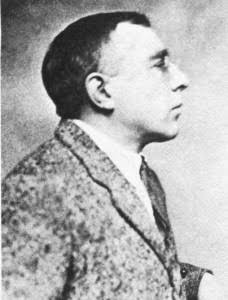
I am now obtaining a better picture of the Yale documents. Ouspensky began writing In Search of the Miraculous by no later than 1926. This draft ends with the words “London 1926”. Other drafts come from later years.
First, compare this with what is on p.33 of the English. The words in this draft but not the English, are underlined:
Sometimes he enjoyed being in noisy and cheerful company. No one could dine so well, no one could be such a hospitable host as G. He loved to host large dinners, buying copious amounts of wine and appetizers, although he often ate or drank almost none of them himself. He impressed many, and often, it seemed to us, wanted to give the impression of being a carouser and gourmet. But it was always felt in him that he was not attached to any of the external goods, every minute he could give up everything without losing a single drop of his energy and his peace of mind.
Now that is an impressive omission. Second, compare this to what is on p.36: “All these stories contained many contradictions and improbabilities. I could never pinpoint the exact point, but some of his travels were more, so to speak, tangible, while others were more vague. Persia and Central Asia were all that seemed concrete; the rest of what he talked about—Egypt, India—were very vague and nebulous.“
Third, Ouspensky said something similar to what follows, but this is: “There was one question I could never answer: what was innate in him, and what was given to him by school, if he had attended school. I often thought about this, and sometimes it seemed to me that G. had hardly had to study, that what he knew was impossible to learn.” This exactly formulates something I had noticed, as it were, from the corner of my eyes, but had not seen clearly enough to articulate.
Fourth, this is also new if redolent of other statements: “I followed with particular interest G.’s ideas in psychology, which gradually unfolded before me. Everything about them struck me with their novelty, power, and originality. I clearly saw that they were demolishing the entire house of cards of Western psychology and, at the same time, placing the study of man and his inner life on a completely new and solid foundation.”
A little later, he says: “G.’s conversations on psychological topics revealed to me the scope and direction of his knowledge. I saw that in the field I knew best, where I could judge without hesitation what was new and what was old, what was known and what was unknown, G. knew more than all that was known in European science as a whole. In this area, I had no doubts. He opened up entirely new horizons for me, demonstrating entirely new possibilities for study and research.”
Fifth, the reference to hashish here was removed from the English: “And several times, while listening to his lectures, I experienced sensations very similar to those that hashish gave me and which I described in the book “New Model of the Universe” in the chapter “Experimental Mysticism”; for example, such sensations were given to me by the “Table of Hydrogens”.
Sixth, this seems to be related: “Some parts of G.’s system were more difficult to understand. There were things that immediately intrigued me and opened up new horizons, but there were also things that I initially took very literally and very naively. It was difficult to shake off the obligatory associations associated with words. Then I was compelled to translate everything into a more familiar language, and in general, much seemed much more familiar than it actually was.”
Seventh, the omission of this from the English is amazing: “This paints one side. The other was even more difficult. Explaining his theories and his system in St. Petersburg, G. demanded that I renounce everything I knew before, although in many cases I saw that he was saying almost literally the same things I had written in my books that had been published earlier or were being prepared for publication at the time. And in some cases, he himself repeated words and expressions from my books, while at the same time demanding that I admit that I had never understood them. In some cases, feeling that I needed to defend myself a little, I tried to show him rough drafts of various chapters of my new book, wanting him to understand that I already knew much of what he was saying. But he paid no attention to this and, as it seemed to me, continued to knock on open doors, explaining to me what I had long known and demanding that I say that I was hearing it for the first time in my life.”
“It was a very difficult discipline, but later I understood its meaning. We may know many things correctly or almost correctly, but alongside them there is inevitably something else about which we are profoundly mistaken—truth in our knowledge and ideas is always mixed with falsehood. Separating one from the other immediately is impossible. To separate them, we must acknowledge everything as incorrect and begin building on a new foundation. Then truth itself will separate from falsehood, and what was true can neither suffer nor disappear; it will remain whole and unharmed, and even if a person renounces it at the beginning of the work, it will return to him.”
“You shouldn’t be afraid to throw everything into the fire,” G. said. “What’s real won’t burn. What burns isn’t real—it’s trash, newsprint. Thank God it burned.”
“And later I agreed with him.”
But looking back, I’m still amazed at my courage—for example, that I could accept his “three-dimensional universe” after all I’d written and thought about the fourth dimension. Although at the same time, I fully understood that it was necessary to go through what I did, since there was no other way to get from G. what I got. When I started arguing with him, he stopped talking.”
This is a most remarkable passage. It goes some long way to explaining the sternness of how Ouspensky took groups – it was a hard lesson which Gurdjieff had taught him, and taught him very well.
Thank you Joseph, for these further amplifying posts.
The entire time while re-reading them in whole and in part, the question kept arising for me:
I wonder if Ouspensky ever considered that his insistence on maintaining his position as a teacher after his final break with Gurdjieff was a return to the “comforts” of his initial isolated stance? While all facts are not known, as these three posts readily indicate, such a move on his part, could be seen as being an explicitly repeated personal remove from what he seems to imply as the “hoi-poloi” nature of Study Groups.
Self-Removal and its cohort Escapism were always part and parcel of Ouspensky’s overall psychological baggage, in my view.
I’m not all that certain (other than an initial, eventual “getting through’ as a concept) that what Gurdjieff taught him was all that thoroughly integrated by him. Yes, I see him going through the formal paces of performative (outer) imitation, but I am never sure with Ouspensky concerning the exact nature of the embrace beyond that level.
While I would never question the intrinsic value of his journalistically reported facts — such as they are —-he remains essentially suicidal in my view, so I always read him with an abundance of caution.
Over the passage of time, I have managed an increasingly sincere pity towards the ongoing tragedy of his singular predicament even as I have next to no time for his shield of arrogance which always feels sourced in dangerously unresolved personal fears.