I have previously written about Nicoll’s use of the concept of the puer aeternus, the eternal boy: https://www.josephazize.com/2024/10/24/maurice-nicoll-the-sun-octave-and-the-miracle-of-life/
It was probably borrowed from C.G. Jung, although, from what I can see, he said very little about it. In Catafalque, Peter Kingsley wrote of: “… Jung and Corbin’s simple warning that the only true puer aeternus is not the child who wants to remain a child but the young boy who has been born directly “from the maturity of the adult man” (751 ). I am not going to pursue this line of enquiry through Jung, Corbin, or James Hillman who also wrote some material which may, arguably be relevant. I will, rather, recap what I had written before, based on Maurice Nicoll’s work, and then come to the Christ Child.
First, I wrote in the above post: “Nicoll speaks of the Puer as an intermediary between the higher and lower centres. If I want to mount from the earth to an elevated level, I need to take a step. Depending on their relative levels, it may be one or more steps. But the point is that the Puer represents a dynamic movement—the taking of a step: an internal action related to something higher which I sense. As Nicoll notes in his commentaries, this is what Our Lord was referring to when He said: “Except you become as children …” There is no actual Puer, nor do I make something. Rather, the Puer aeternus is a symbol of an active, curious, yet innocent aspect of ourselves which dwells in our essential being. That aspect can enter into our being-state and our being-attitude. Perhaps because he is a symbol, or even better, a sacred image, Nicoll made much of a statuette of the Puer.”
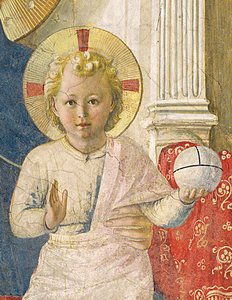
I think there is more to say. It seems to me that the truth behind the idea of the Puer aeternus is conveyed, and powerfully, in the Christ Child. It is said that St Francis of Assisi set up the first Nativity scene in Italy in December 1223. The veneration of the Child Jesus picked up steam in the 17th century. The illustration with this post was painted by Fra Angelico and his assistants between about 1438 and 1445. I recently saw the original, still on site, at the Monastery of St Mark, Florence.
The child or puer is eternal (aeternus) not in so far as he refuses to grow old, but because the qualities of purity, innocence, wisdom, potential, goodness, and clarity of aim and purpose, which he so clearly embodies in such a painting as this, are beyond all time, and yet they enter into it. This is more than I had originally understood.
The Infant is related to the return to God. We have come from God, and to Him we must return. We came as souls, took flesh, and the last developed stage of our purity was as infants. This was the point at which the original confronted the acquired: when essence met personality, if I can adapt Gurdjieff’s terminology in that way.
We cannot remember the moment of conception, although its influence is always with us. Neither can we remember life as a foetus, or the very first days and months of life on earth. But we do have a memory, ineradicable, within ourselves, not so much of being infants as of the quality of being we had. There was a singularity, an individuality about us, which was not developed, but was still real. It was a time when we wondered at the reality of life around us, and we could—for longer or shorter periods— be with other people without any taint of jealousy or resentment.
Consider this portrait. Ponder it. Feel yourself before the image as a whole, and its parts. The wisdom and knowledge evident in his right hand. The certainty in the left hand which supports the orb of the world. The something ineffable in His mouth, His chin, His eyes, the way His hair shines and falls over His forehead.
If you see the full fresco (titled Madonna of the Shadows, although Fra Angelico did not give it that title) you may sense something in how the feet of the Holy Child come together, forming a counterpoint to the crown of His head.
He is holding the All in His hand. He is a child and yet He is perfect in wisdom and all His divinity. We cannot say that we are, in some way, the Christ Child, but rather that something in us, some quality of our soul, corresponds to Him and what He represents.
This is, I suggest, an indication of the nature of the return. This, as I began to realise when I wrote the earlier post, is the nature of the struggle against False Personality. We have a past, a history, and it is a chronicle of much we would like to be able to forget. Ouspensky said that if he could be granted a wish it would be to able to forget what he wanted to forget.
But the return to God is not so much a forgetting as a looking past those events to the Christ Child, who participates in our human lives. It is not me as a child, you as a child, or Dr Nicoll as a child; it is, I venture to think, something from a higher level which can never be soiled, never tarnished precisely because it comes from a higher level. It is beyond the reach of our grubby hands. And we all have it within. Even our memories of childhood are of ourselves in relation to it.
St Bonaventure, himself a master of the spiritual life, wrote of St Francis’ first creche, words which form a fitting close to this post:
“It happened in the third year before his death, that in order to excite the inhabitants of Grecio to commemorate the nativity of the Infant Jesus with great devotion, [St. Francis] determined to keep it with all possible solemnity; and lest he should be accused of lightness or novelty, he asked and obtained the permission of the sovereign Pontiff [Honorius III]. Then he prepared a manger, and brought hay, and an ox and an ass to the place appointed. The brethren were summoned, the people ran together, the forest resounded with their voices, and that venerable night was made glorious by many and brilliant lights and sonorous psalms of praise. The man of God [St. Francis] stood before the manger, full of devotion and piety, bathed in tears and radiant with joy; the Holy Gospel was chanted by Francis, the Levite of Christ. Then he preached to the people around the nativity of the poor King; and being unable to utter His name for the tenderness of His love, He called Him the Babe of Bethlehem.”
This posting could not be more timely for my reading of it. A portion of it also goes a long way to trigger an answer to a question I have held generally for quite some time and which I have held in a deliberately specific form for the past 16 days. For the considerations which you have laid out here, I could not be more grateful. Thank you, Joseph.