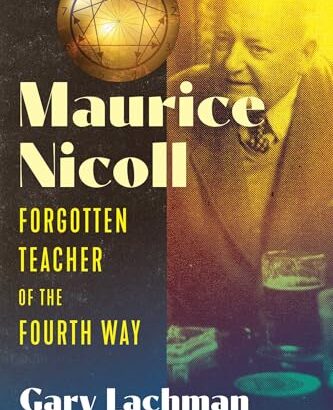
I am unable to recommend this book. My understanding is that Lachman was invited to write this book by a Swedenborg organisation, but that at some point their relations were not sufficiently buoyant to maintain a productive connection. He mentions that someone suggested it to him, and that another gave him the transcripts of Nicoll’s diaries, but unless my sources are wrong, while quite true, this omits as much as it discloses.
The major problem I have with the book is that Nicoll’s achievement is not recognised in anything like adequate terms. I would agree with Bennett that Nicoll was one of Gurdjieff’s leading pupils. Although his personal acquaintance with Gurdjieff was quite brief, and unlike Bennett, he never returned to him, yet he made something real for himself. All one has to do is consider the numbers of serious men and women who joined his groups. Further evidence for Nicoll’s discoveries are found in his Psychological Commentaries, The New Man, The Mark, and perhaps especially in the notes of group meetings with him. These are mentioned in Lachman’s book, but I find the treatment of them is rather meagre (the bottom of p.385 to the bottom of 390 for New Man, but nothing for The Mark). Further, slim but significant works such as the Simple Explanation are quite absent. Nicoll’s treatment of Gurdjieff and Ouspensky’s ideas (because he did take Ouspensky’s contributions very seriously) is masterly: clear, deep and practical. I doubt anyone reading this book, even should they do so ever so carefully, would realise that.
There is an over-emphasis on the contents of the unpublished diaries, augmented by reference to the sexological views of Colin Wilson, of all people. For example, on 87, he quotes CW to the effect that: “The major component of the sexual urge is the sense of sin … the sense of invading another’s privacy, of escaping one’s own separateness.” And “Without the sense of violation … sexual excitement would be weakened, or perhaps completely dissipated.” I have not read Wilson to ensure this is a fair quote, but it is hard to believe that someone could write this imagining it to be a general truth. It might be true for certain individuals. If so, it is a description of their pathology. The sexual function can only be well discharged if there is no sense of violation, no sense of sin. Whatever Nicoll may have said and done, at times, and there is quite enough speculation in these pages, my point is that GL cites CW as if it were scripture of universal application. Likewise, GL speaking in his own voice, writes “Nothing gives a man more confidence than sexual conquest.” (97) He might speak for himself. I do not wish to make this short review a critique of GL personally, so I will pass on.
While too much of this book is fruitlessly concerned with sex, one of the most significant events in Nicoll’s life is passed over: how Gurdjieff had all those at the Prieure stay up for “most of the night doing unusually difficult exercises in order to create the force which he was able to use to cure Jane … when she was very ill. He and Mrs Nicoll always felt that he in this way saved (two year old) Jane’s life.” (Informal Work Talks, 82). When I picked up this volume, I was quite looking forward to reading about this, and seeing whether GL had discovered more about it. I was disappointed to find it entirely absent. But it is quite significant. What did Gurdjieff do? Are there any known parallels? How could Nicoll have left Gurdjieff, the man who saved his daughter’s life, and not constantly sought him out?
Neither is there any treatment of the exercises which Nicoll did before going to bed, and the one of moving “through the Time-Body,” learnt apparently from Gurdjieff (Pogson, Maurice Nicoll, 91 and 252). GL does not even mention them, and in failing to do so, the portrait produced makes Nicoll seem more of an intellectual type, less of a balanced man, than in fact he was.
Nicoll remembered and passed on some very important statements of Gurdjieff’s which would otherwise have been lost. I have reported some of them on this page, e.g. that “Behind real ‘I’ lies God.” Here is another one:
He emphasised that if anyone made an effort in his mind towards someone it was not lost in the total Cosmos. It would be sure to get there eventually; it was like posting a letter. It was wrong to think there was no connection because the London (Nicoll group) people were not present visibly. In the psychic world people can be present or not according to what you think. We have to learn to live in the psychic world. If you murder a person in your thoughts you are ruining your psychic world.
He said of sacrifices that people, more conscious in the past, tried to put the pain into animals by killing them to avert the pain of wars, etc. for Man, knowing that a certain amount of pain was necessary for the world (to feed the moon). Gurdjieff had said the Moon did not require so much pain now, but wars went on from habit. (IWT 17)
I could go on providing such gems, valuable material which the book under review passes over. My sense is that Nicoll actually knew the first part, about the psychic world, for himself. Is this not significant? I shall refrain from commenting on Nicoll and Swedenborg, for Swedenborg did become very important to Nicoll, especially in his later years. But if GL had examined the ideas in New Man and Mark at any length, he could have shown where that influence appeared. That would have been a contribution to the literature.
We have a skewed idea of Nicoll in those last years. Living Time, an extraordinary study in my view, was published in 1952, although written long before; and by the time he wrote those later books, he had further ripened. In particular, he had developed an understanding of “the Work” as a force, an impulse, a voice. It is one of the striking features of how Nicoll wrote and spoke. But if GL refers to this at all, I missed it. Further, from the unpublished diaries, Nicoll started to develop an almost unique way of conversing with a higher element of himself, perhaps the Steward or as Gurdjieff said was possible – instinct. Now, as it happens, Bennett had also come to this point. That, it seems to me, is very important. It may also explain why he did not return to Gurdjieff: he now had a source of authority within himself.
Neither does GL ever explain why he sees Nicoll as a “forgotten” teacher of the Fourth Way. I could challenge this, but there is little point: the idea appears in the subtitle but is not explained.
Another major feature of Nicoll’s achievement which this book does not bring out is his linking the Gurdjieff Work to Christianity, or perhaps more precisely, showing how the Gurdjieff Work can help one to be a Christian: to do what Christ commanded. In the process, he reconfigures our picture of Christianity; we see in the Gospels meanings and above all, levels of meaning, which we had not realised. It also had the effect that the Work looks different, because it was no longer separated from Christianity by a gulf, but was rather a land bridge, joining the valley of ordinary life to the high road, the higher level on which both the Work and the Way can be lived out. This was a major and massive achievement: it meant that many good people, otherwise suspicious of certain elements in the Work came and still come to find that the eternal values they had been taught to think illusory were real.
In a word, in all this discussion of sometimes eccentrically selected things Nicoll said and did, his being is missing. For me, the main value of this unfortunate book is that it has strengthened my resolve to ensure that the Gurdjieff Society of Newport works with those who have the requisite knowledge and being to produce a volume worthy of Nicoll and his achievement.
I could not agree more!
Which Newport? Where?
On the northern peninsula of Sydney, Australia
Mr. Azize,
As a fellow laborer in this Work and as a grateful reader, I want to thank you for your courageous and clarifying review of Gary Lachman’s book on Maurice Nicoll. You write with the sobriety of a practitioner and the discernment of one who understands what is at stake when a teacher’s being and contribution are weighed in public. Your critique restores proportion where it was lacking and guards the heart of the matter: Nicoll’s living achievement in transmitting the Work with clarity, depth, and practical power.
My gratitude comes from one whose life has been formed by Dr. Nicoll’s teaching for over forty-five years. I have found in his Commentaries, and in the spirit that breathes through them, a trustworthy architecture for inner work—something exacting yet merciful, demanding yet suffused with hope. In your review I recognized a rare fidelity to that reality. You did not merely defend a reputation; you safeguarded a lineage of understanding. Where others dabble in speculation and imbalance, you insisted on Nicoll’s true stature: a man who made something real for himself and gave it cleanly to others.
You have prevented a damaging misrepresentation from becoming a reference point for seekers who deserve better. By naming what was neglected and distorted, and by recalling the wider scope of Nicoll’s life and work—the depth of his practical teaching, his relation to Gurdjieff and Ouspensky, his Christian insight, his exercises and inner life—you preserved his importance for the sincere soul who is looking for a path rather than a personality. In doing so, you confronted, single-handedly, an act of public besmirching and turned it into an occasion for truth-telling.
For this, I thank you—plainly and deeply. Your unflinching words have not only honored a remarkable man who helped preserve the essence of Fourth Way work for later generations; they have also become, in their own right, a service to the future. You have reminded us that the Work asks for accuracy of mind, integrity of heart, and courage in action. You offered all three. May your example strengthen others to do the same, so that what is essential in this teaching continues to be received in purity and lived with understanding.
Thank you. I have commenced work on a study of Nicoll’s achievement. To that end, I am collecting all his writing, including the unpublished material. Keep tuned for more Nicoll material.
Thank you for this review. I am in the beginning of my study of Nicoll. I have published something about his contemporary, Valentin Tomberg, and am quite familiar with “Meditations on the Tarot”. Both Nicoll and Tomberg seem to me to have been seriously engaged in building bridges between Christianity and esoteric movements (anthroposophy and the Fourth Way).
I recently discovered your web page and am learning many fascinating and important things. Thank you for all the effort you dedicate to this project. It is much appreciated.
A pleasure. This is also the time to announce, the Gurdjieff Society of Newport is going to publish Nicoll’s “Pelican Hotel.” It is an astonishing novel. Regards,