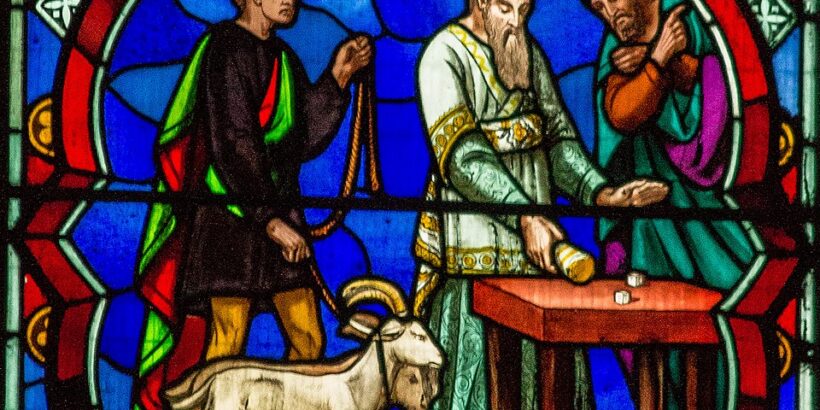
3. Judas as “the Scapegoat”
The Judaic tradition of the scapegoats, which has analogues to Middle Eastern rites, is intrinsic to the Passion and Crucifixion of Christ. Two goats would be selected, one was sacrificed as a sin-offering, and the other was sent out. In the Gospels, these are exemplified by Barabbas (the goat bore the sins of the people and was released into the wilderness) and Christ Himself (the goat which was sacrificed as a sin-offering). Bennett does not draw this connection, but it has an essential affinity with his idea that Judas was able to “absorb,” as it were, satanic influence so that it could not interfere with what Jesus was to do. Since Bennett believes that the critical event was the death of Jesus, not the Last Supper, then we should, I think, understand that Judas’ action made it possible for Christ and all the Apostles to fulfil their roles. For this to be so, then Satan had to be “expelled” (68). I am not sure what it means to say that Satan could be expelled, and Bennett does not explain. However, it is clear that he means Judas did more than just buy Christ some time, and nothing more.
The idea of a scapegoat, or a Judas who undertook that Satan should enter into himself in order to leave others free, makes logical sense. Only, is it true? How would it work? Can either a devil or a cosmic force be enticed to enter one person, and thus to leave others free? It is an imaginative and bold idea, but I can see no basis in fact or theory for it.
I am, in short, sceptical of Bennett’s ideas. As I have commented elsewhere, it seems to me that the Gospel of St John is too clear to admit of any doubt. This applies also to Gurdjieff’s statements about Judas. However, what lies behind this: i.e. Bennett’s idea that we need to be humble (if not humiliated), clean of heart, to be able to receive that Love which will fill our heart. Mr Adie and Mrs Pogson, although I doubt they knew each other, both saw the same truth in Hercules’ cleansing of the Augean stables. Yes, there is something in that – I am sure. But although I have considered it from many sides, I have been able to relate that truth to the Gurdjieff/Bennett narrative on Judas.
4. Essenes
Further, if we agree with the many who identify the Essenes with the Qumran community, then we have a further problem: Bennett sees Jesus as having developed Essene ideas, e.g. that the Sermon on the Mount is a development of the “so-called Manual of Discipline” of the Essene Brotherhood.” (61) I am rather surprised at this: the Manual (now known as the 1QRule of the Community) is a relatively lengthy document, with a great deal in it about priests and proper hierarchy. Here is one passage: If (someone who has been negligent with the Community’s property) does not manage to replace it, he will be punished for sixty days. And whoever feels animosity towards his fellow for no cause will be punished for {six months} … And whoever walks about naked in front of his fellow, without needing to, shall be punished for six months. … And whoever giggles inanely causing his voice to be heard shall be sentenced to thirty days. … These are the regulations by which the men of perfect holiness shall conduct themselves, one with the other. All who enter the council of holiness … who breaks a word of the law of Moses impertinently or through carelessness will be banished from the Community council …” (The Dead Sea Scrolls: Study Edition, F.G. Martinez and E.J.C. Tigchelar, vol. 1)
It strikes me that this is not just different in many particulars from the teaching of Christ: it seems to me to evince a very different one, one more narrow and formatory (in the Gurdjieff sense) than that of Christ.
I may be wide of the mark, but it seems to me that the preparation for the coming of Christ was the Jewish people as a whole (in order to receive His teaching), and his immediate family (Mary, Joseph, John the Baptist, etc.) in particular, to raise Him and give Him a helpful social and family environment. Other than this, Jesus was incarnated with a divine being and mind. The idea that he might have needed to be taught by Essenes strikes me as wrong: had He been taught by men, he would have been an ordinary man. Rather, His revelation was His direct knowledge. Bennett gives many examples of what he learnt in that way, and he was one inch to the Lord’s six feet.
So these are approaches I do not think will help.
5. Divine Love
In volume 4 of The Dramatic Universe, Bennett makes some significant comments which for some reason or other did not make their way into The Masters of Wisdom, although I do think they fit there. Based on his general understanding, and his knowledge of history, but most of all, I think, on his experience of Divine Love, he wrote these significant lines, and with these, we are back on firm ground:
The (Christ) Event was beyond understanding, chiefly because it belongs to the Realm of Impossibility that lies outside Existence itself. To unmake what had been made and to redeem mankind, an act of Will was needed that would not destroy Existence or even the smallest part of it. … a new power was to work and this was to be the Unitive Energy or the Power of Love concentrated within a living man. The Unitive Energy … did not enter the human soul-stuff together with creativity. … Love entered the soul-stuff of humanity with the Incarnation (of Christ). … It is not to say that there was no love before the time of Christ: the Incarnation being hyparchic, its effect would be felt in all history. Nevertheless, it is very noticeable that the significance of love did not penetrate into the human mind-stuff until the time of Christ. This can be noticed in non-Christian traditions such as Buddhism. All Buddhist texts earlier than the first century A.D. emphasise the ideas of causality and liberation, but not of compassion and redemption. The same is true of the Hebrew Scriptures which, with one notable exception, never ascribe love to God, but do require it of man. Nevertheless, the (Hebrew) prophecies foresee the coming Redemption and in this they differ from their Buddhist and Hindu contemporaries. (345)
In the third instalment, we consider some insights from Beryl Pogson; return to Bennett on Divine Love, and round out Bennett’s ideas to come up with something which is fairly serious, of practical application to yourselves, and related to the Easter Mystery.