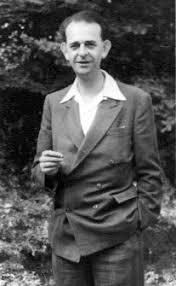
When I met Mme Solange Claustres, she asked me whether I had ever met Michel Conge. I had not. “He was very good,” she said. In the context of our conversation, it was not so much a statement about him, as a reminder that there are good people in the world, that real development is possible.
Since then, various collections of Dr Conge’s material has been made available. And now, two volumes of selections from group meetings with Michel Conge have been published under the common title Knowing Oneself-Working on Oneself, one is from 1963-1964 and the other 1964-1966 (SET, 2023).
They are quality artefacts, nicely presented, on good quality paper, and quite legible. There is some excellent material in them, but the books suffer from overly drastic editing. More about that below.
Conge came to possess a clear and enquiring mind. The encounter with that mind constitutes, I think, the chief value of this set. He has a remarkable way of addressing issues, often pithy, occasionally making reference to other traditions, the Gospels, Hinduism, Zen. But he is speaking as one having authority (Mark 1:22 and others) rather than as one who claims authority from his wide reading. What he says about feeling and emotion is valuable (71, 1963-4) and likewise when he speaks about one of his favourite topics: the need for an aim (137, 167, 1963-4). Thus he says: “Without an aim, it is impossible for us to even try to understand the lines of work, it would be meaningless” (137).
As I said, there is some very good material here. Conge rarely refers to Gurdjieff, but these are sometimes enlightening: for example, on p.50 of the 1963-4 volume he cites Gurdjieff as saying: “The functions need to be spiritualised.” Shades of Meetings. It is enigmatic, but it makes an impact. From the same volume, “Mr Gurdjieff used to say: ‘Time for work; after, to hell with it all.” (102 and 172) And, of our field of work, “it has not been ploughed.” (122) “Let Devil help you, Angel too, but in between may God keep you.” (145) This is a warm saying, perhaps unexpected from Gurdjieff, but a real Work blessing. “It is better to suffer for a few years here than after” (196). This seems to be a reference to the after-life.
Conge also makes some interesting comments about the Work: “The Teaching gives me a direction, if there were no direction, I would stay forever sucking breast milk.” (117, 1964-6) and “The orientation of the Work itself must become the guideline for all your efforts.” (167, 1964-6) These comments of course relate to aim, but they shine a light on how the Work itself and its ideas can support it, even if we are floundering about without a clearly defined aim – but with such an aim, they keep us on a productive line. For example, this advice is always valuable: “Try to keep coming back to ‘I am,’ it is our only possibility and we always forget it. Whether it is in the Movements, in the quiet sitting exercise or in a task, no matter whichever, I try to return to this taste, to this certainty: “I am here.” (154, 1964-6)
Perhaps the most important comment is: “Mr Gurdjieff, and it did not trouble him in the least, said one thing one day and the opposite on the other. “Your I not exist,” he said, and the next time he spoke of it as an ever-present reality. Over time, we realise that the two are deeply compatible: the “I” exists but since it has no defined structure, we are taken over by the current structure.” (197, 1963-1964)
Sadly, so much material has been omitted, that the good doctor’s wise words often disappear in a cloud floating somewhere above our heads. There is no doubt that he is giving good advice: but about what?The questioners make reference to exercises, but we have no clue as to what the exercises consist in. The editors did not want to publish the exercises in full. That is their choice. But then, either give us some context, or else leave out the exchange altogether. No one obliges them to publish anything, and I am sure there must have been more material than this, but if you do publish, why select something too vague to come to grips with? Apart from the exercises, questions rarely extend for more than three lines, and are often even shorter. Of course, editing is needed – but when it is as radical as this, we cannot follow how the answer responds. For example, in the 1963-1964 volume, take pages 128-129. Conge asks a question, and the response is: “It is hard to define.” What is hard to define? I was unclear. But Conge’s answer begins, “And yet when I touch it, I cannot be mistaken. I can be tempted to make it last …” If there is any point in publishing a book, there is a point in saving us from having to guess what it’s all about.
The books are of some worth, there is some excellent material here, but they suffer from a certain vagueness and impenetrability, which is, I think, a function of the editing. It is also a shame that no attempt was made to open and close with powerful material. The second volume ends with the pointless “…. there are many tasks that could be very useful to us given the stage we are at in the work on impressions.” (190, 1964-6) If only the anonymous editors had obtained an opinion from someone outside their caste.
Hi
I have not been able to find this book anywhere on the internet.
Do you happen to have a link or a website where I might be able to find it?
Best regards
I am sorry but I don’t. It seems to have disappeared.