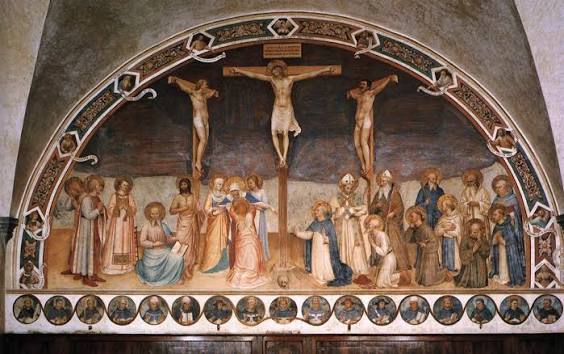
I recently made a pilgrimage to the monastery of San Marco, Florence. A friend of mine, also in the Gurdjieff work, had told me it was extraordinary; and Fra Angelico is, with Leonardo, my favourite painter. Half the art in my house is Fra Angelico. It was time to go; besides, I needed a holiday.
The pilgrimage more than answered any prayers and hopes I had taken with me. When I entered, I was first struck by the fresco which is at one end of the cloister, of St Dominic at the foot of the Crucifix. But then, when I saw the fresco often called Crucifixion and Saints, in the chapter room (5.5×9.5 metres), I was thunderstruck. Then, the more I stayed before it, the more I could perceive details which I had never noticed in the books or prints. Of all these details, I need only refer to the quality of the eyes of the saints. They are phenomenal.
Receiving the impressions from those eyes, I could read being-feelings which I had not known could be communicated through art. At a certain moment, a door between two centres was opened, and a new connection appeared within me; leaving me with a feeling as if a pool of stagnant water had been cleansed. I will not waste words trying to explain it or describe it: I know I am not a sufficiently talented writer. But I immediately had a strong sense that this was a spiritual power house.
I have visited many sites: the Pyramids and Sphinx at Giza, the Taj Mahal, St Peter’s in Rome, a number of Gothic cathedrals, Newgrange, Glastonbury, Lindisfarne, holy sites in Lebanon and Israel, Delphi, and so on. But none of them had the effect on me which the monastery of San Marco did. Or, to put it more precisely, I have not ever received impressions such as these anywhere else, at any time in my life. It is not a sizable but not a huge monastery. It is not just the art-work, sublime as that is. Neither is it the fact that one sees the frescos in the very places for which they were created (before the modern period, no one thought their works would be hung in a museum).
I almost wrote that the effect is made by the inner work realised in the monastery, not the frescoes themselves, but that is a false dichotomy. Fra Angelico and his assistants were working on themselves when producing the frescoes, and they must have been catalytic elements in the spiritual struggles of the monks who inhabited the rooms where Angelico painted.
If there were any doubt that inner work localises higher hydrogens (to use Gurdjieff’s term) which can soak into the very bricks and mortar of a building, it will be removed when contemplating San Marco, that is, contemplating within San Marco. Their efforts have left many palpable traces, and only some are the frescoes. But then these remarkable productions serve to concentrate the three-centred gaze; they provide a focus for the eye, and thus a support for the inner.
Now there are certain exercises from Gurdjieff about looking. I used those which I knew, and they still have an effect: I can make those efforts now and revive something of the experience within me.
Much else from this pilgrimage is worth the telling, but again, I know my limits. I would, however, heartily recommend visiting Urbino and Venice. Urbino, I suspect, was also a centre of inner work. I met a most extraordinary man there, but what he said to me was confidential. However, I am not, in retrospect that such a life-changing encounter should occur in Urbino. As for Venice, the great visual effect is the water. But at St Mark’s I also felt that some real inner efforts had been made, although the traces were not so strong as at San Marco. At least, I did not feel them to be so strong.
I had thought of adding some words about the value of making pilgrimage, how it provides an opportunity to disentangle oneself from habitual associations – but that will not come by itself; it always needs an inner effort to de-identify, as Mr Adie said. Yet, if one is willing to look inside, the fact of being in new surroundings can help one discern what in our thoughts and feelings is fresh and what is not. In other words, pilgrimage can give us a degree of perspective on our habitual selves. It cannot make us new men, but it can help us to see and clear out the old, and make way for the new.
More than any other time when I have been at a gallery, museum, or grand house, I realised on this trip how much more can be gained standing before the original work of art than seeing it by any other medium. I had long realised that the possible power of live theatre surpassed that of television and film, notwithstanding special effects and the editor’s hand.
But this pilgrimage to San Marco showed to me that sometimes art is living. As I remarked to a friend, when I saw Michelangelo’s David, I had distinct impression that the statue was more alive than we who were thronging around it. “Absolutely!” he said, “Absolutely!”
Twenty-six years ago this August, I had very nearly exactly the same experience of San Marco, Joseph.
A dear friend took me to Europe for an extraordinarily memorable birthday gift and asked what I wanted to see in Florence.
“San Marco” was my response.
Strangely, after a previous 14 visits there he had never known of its existence. And he was so grateful once entering it. Amazingly to me, people still don’t seem to know of it.
I was there nearly an entire day and had my lunch break sitting looking at the della Robbia medallions on facade of the Ospedale degli Innocent / the foundling hospital, before returning a couple of more hours.
The often synaesthetic quality of the coloration bears much time spent
You don’t mention THE TRANSFIGURATION fresco. I hope you were able to see it.
Having an early evening entrance to the Galleria dell’Accademia I had a good long time there as well, mostly alone. My immediate and completely unexpected reaction to Michelangelo’s David was being in the presence of an immense figure of warm, pulsing flesh. I also telescoped his oft-commented strange measurements into a figure that only made complete proportional sense when actually standing there.
He IS alive.
After years of reproduction burn-out with regard to this famous sculpture I was in no even small way prepared for how completely supernatural it actually is.
The fact that marble is rendered flesh (not “flesh-like”) and without any cosmetic aid of coloration is unequivocable evidence of Michelangelo’s rare abilities for practicing love in art; he quite literally through the subtlety of his love brings the inert and moribund into fully breathing life.
In that point alone, David is (for me) a fully Christian work of art.
Thank you, Gregory. This is a contribution. Yes, I did see the Transfiguration, and everything on show. I just didn’t mention everything which came to me. I had a large framed print of the Transfiguration at my apartment in Chippendale. When I sold it and bought this house in the country, I had some tradesmen come in to do some work. One of them was so moved by the Transfiguration that he asked if he could have it in lieu of the agreed wages. I gave it to him, chiefly in honour of his feeling.
Very interesting, Joseph.
I, too expereinced this wandering of the psyche over all elements of San Marco. Sometimes it was a fresco. Sometimes it was a limed wall. Othertimes it was one of those incredible heavy wooden doors with its iron fixtures, or wooden shutters with the sky view beyond. Then it was back downstairs to a panel painting.
It is the entirety of it all, as you say. And it is indeed “soaked”.
Upon entrance, without reserve, I wanted to work and live there.
From my mid-teens through my late twenties, I kept a framed color reprocuction of The Transfiguration by my bedside.
Stepping off the train into Florence, the day I saw David and the day before I entered San Marco, I understood through the crystalline, sunflecked atmosphere the Florentine painters judicious adherence to gold-leaf. An art historian will trace the line back to Byzantium but the two usages are really nothing alike.
Thanks for an exact recapitualtion of all this. I’ve never had a place where I could thoroughly discuss it.