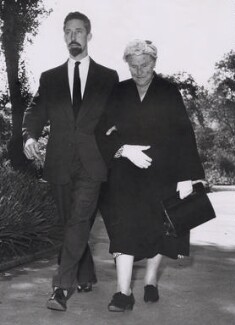
Clive Entwistle (1916-1976) is, for us today, vitally important. A student first of Ouspensky, and later of Gurdjieff, he was also something of an autodidact. Perhaps the most important lesson he ever had was the one he learnt for himself, after having met Ouspensky, but before he went to Gurdjieff. This is why he, I suggest, vitally, important. There is life in his example.
He was in Paris with Gurdjieff in 1948 and 1949, wrote to Jeanne de Salzmann on 24 April 1975:
“It is my impression that the work of self-transformation as described by Gurdjieff, is, within the Foundation both here and in England … not going forward along a road but turning in a closed circle. This circle can be defined as DO-RE-MI-DO-RE-MI-DO-RE-MI, etc. For a group as for an individual, the passage to FAH requires a shock from outside, that is from above. The nature of this necessary shock is quite specific and real and in its absence the further inner growth of an individual, at least in the fourth way … cannot take place. … I write from my own experience. … Bridging the MI/FAH interval in the work requires the shock of a flooding in of Higher Emotional Energy. This can occur exclusively and only by a connection with the Great Accumulator, or universal reservoir of higher psychic energies. … “
Consider the photograph taken of him in 1957. You can see why Gurdjieff referred to him as “Mephistopheles.” Like Gurdjieff’s hero, Beelzebub, that estimable character represents a principled, if mistaken, rebellion. So Gurdjieff was probably implying that Entwistle was his kin. I am reliably informed that Gurdjieff said that Entwistle was his essence-friend.
Entwistle had a tremendous life of achievement, understanding that the true achievement was inner, not external. I won’t enter into the biographical details right now: I want to go to what is most important for us – his discoveries.
I was kindly sent by Donna Sherwood, Clive’s wife, a copy of his unpublished book, Foundations for a New World View, a work which I can only compare to Bennett’s Dramatic Universe. Consider this portion from Chapter 7 – Section 8: “Higher Energy States – a Personal Experience.” Bear in mind that what this man is saying is true. It is the spring of 1941, and the fact of the War had a significance.
Those who know from experience will understand why it is critical that, at this juncture of his adventure, he had been working on the exercises for stopping thought which Ouspensky had taught: a matter which Mr Adie also considered of the first significance – in fact I recall he once said that the very purpose of all our efforts was to stop thought. I won’t present all the details of his efforts, it is enough to give this provisional conclusion: “I clearly remember the first time that I passed a certain threshold whereby this state of sharp self-awareness coupled with complete inner quiet maintained itself quite stably without the need for this continuing intensive inner effort (to stop thought as soon as they emerged into consciousness).” [p. 387]
He spoke to some other people from the Ouspensky group, who told him that they considered his experience to be impossible, meaning, that it was impossible it last as long as he stated it had. He visited Watkins’ bookshop in Cecil Court, and there found Boehme’s Dialogue on the Super Sensual Life, “at once sensing its relevance to my current experiments.” [p. 388] Incidentally, Mr Adie once read to us from that book, considering it to be the Work, exactly, only with a different vocabulary. He then received an invitation to stay on a farm in Battle, Surry (about 50 miles south east of London).
At Battle, he often experienced “a beautiful sense of union with nature, as though the trees, leaves, moss and water had somehow come alive and were communicating their essence to me in a way that seemed somehow familiar, as though recollected across the barriers of childhood amnesia from early infancy.” [p. 388] But nice as that is, it is not the experience, and he knew that there was more. He experimented with fasting – again an important feature – and in this condition he increased both his physical and mental efforts. He had been eating nothing, and was drinking only water for three days. This is not, therefore, an ordinary effort.
Again, I won’t go into all the details. But he remembered God, and he had an experience of profound humility (he had earlier mentioned how pride was inimical to coming to a higher state if being.) [p. 389] Then:
I realized in a flash of clarity that it was meaningless to expect the opening of a spiritual connection between me and something vastly higher and nobler than me at a time when I was totally insulated from such a current by the heavy dielectric (?dialectic) of my own egotistic husk. So, although I felt wholly discouraged from any further direct attempts at establishing such a connection from my end, from down under as it were, I decided out of a certain contrition or remorse to pass a further day of fast and physical effort without any expectation of reward, and thereafter to return to London. Strangely, this impartial attitude toward myself gave rise to a new feeling of inner freedom. [p. 389]
Not long afterwards, there was a breakthrough. A strong and gentle will which, he insisted, was not his own, appeared in him. [p. 390] Entwistle experienced real “I”: “But in spite of his high descent this I does not judge, is not censorious. I feel even a warm love for that all too human “I” that I have now superseded for it was by his sincere wish and invitation, precluded by his clumsy but well-intended efforts that now have been born in me.” He added:
But the most extraordinary thing, here now, within this strange but familiar body that has served to receive me, is that I sense an essence kinship with this immense and magical celestial world. I am not afraid of it. I like it because I am like it, I am from it, and my destiny is to return to it: God-Man, Man-God. Man is the son of God because God is infinite and perfect Man the father. [391-392]
I shall conclude with this passage:
There is an element of paradox here in that this immensely strong and consciously alive infant that has just been born in me is far more intensely “I” and my real self than any former “I” that ever arose within my common presence, but at the same time I sense a complete continuity of memory and experience with all that went before. The overwhelming reality is that this extraordinary psychic birth has actually happened and that it seems unshakably stable on a far higher more intense level of consciousness than I had ever experienced or even imagined to be possible. Yet there are no visions, no blinding white lights. It is not the state of objective consciousness or what I now call Consciousness Five but a stable and extraordinary elevated state of what had formerly always been so fugitive and hard of attainment, Consciousness Four. [pp.393-394]
You can see from this alone that, in Clive Entwistle, we have found a powerful, systematic, and practical mind. I have left much unsaid, but it is necessary to say something. If anyone has any information about him, please share it with me. This man is the man Gurdjieff described as his “essence-friend.”